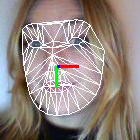

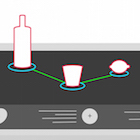
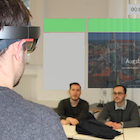
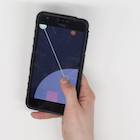
Human-Computer Interaction Research is a university-level course by Prof. Dr. Michael Kipp at TH Augsburg, Germany. It takes place every winter semester and is open to students from IMS (Master Interactive Media Systems), IN (Bachelor Computer Science), MIN (Master Computer Science) and MAPR (Master of Applied Research). It consists of weekly sessions of 4 units (4 SWS). The outcome of the course is a running interactive prototype: See previous course outcomes for reference.
The course language is English.
The title of this course has changed from "Interaction Engineering".
What will you learn?
Human-Computer Interaction Research is a pragmatic and applied approach to the research field of HCI. The main goal is to find novel methods for human-computer interaction by including touch, gesture, posture, facial and bodily actions. We use novel methods to make the interaction more intuitive, immersive, enjoyable, natural or efficient. This includes the development of prototypes and the evaluation of these prototypes, both objectively (measurable aspects) and subjectively (user feedback), usually in a comparison against a conventional system or in a comparison between variants. We also consider Artificial Intelligence both as a driver for interpreting input as well as a system to interact with.
We will discuss the following research areas:
- touch, gesture-based and gaze interaction
- proxemic, spatial and full-body interaction
- tangible user interfaces (TUI)
- interaction in 3D (3DUI), including interaction in Virtual Reality (VR) or Augmented Reality (AR)
- use of AI to support interaction or AI as a system to interact with
For relevant conferences, research papers and books have a look at: Research.
The best way to learn about the course and its outcomes is to look at the projects page with student work from previous editions of this course.
Participants of the course should acquire the following knowledge and skills:
- You know the research field of human-computer interaction (HCI) in terms of research topics, questions and methods
- You are able to summarize, present and discuss research publications
- You can develop own research projects, usually based on existing research, and critically reflect on the pros and cons of a research proposal
- You can plan and implement a running research prototype
- You can productively work in small teams in order to come up with design ideas
- [Master students] You can formally evaluate a research prototype
How much work is it?
During this course you will work on various assignments, give a presentation on a research paper and finally, develop a running prototype of a novel interactive system. The prototypes will be developed in teams of two. Master students will additionally evaluate their prototype. Each prototype will be presented and demonstrated at the end of the semester and will be documented with a short written report and an accompanying video. See the projects page for examples from previous semesters.
For your prototype you can get hardware from the university (e.g. Kinect, HoloLens, eyetracker, leap motion, touch screen etc.) that you can use for your project.
How technical is the course?
During this course we will not go into technical details of the various sensor technologies or how to program them. Instead, you will find various technical chapters about relevant devices and sensors.
(some chapters are in German, marked with [DE only], some are in English and in German)
6 Optical Tracking (Motion Capture Lab)
7 Interaktion mit vvvv [DE only]
8 Statistics for User Studies (introducing R)
What are the requirements?
The requirements for this course are ideally some programming skills, a good command of the English language (reading, writing and speaking) and an interest in working both analytically and creatively to invent new and improve existing interaction methods.
If your programming skills are a little rusty we can have a look at my online lecture notes of the Processing language: Programming in Processing (in German).
What did students say about this course?
Here is selected feedback from student evaluations that may be relevant for your decision of whether to take this course.
Question "What did you like about this course?"
Quick ideation sessions, precise feedback, amount of lecture to group work. (winter 2023/24)
Good balance between DIY and interesting lectures, great supervision. (winter 2022/23)
The course and the lectures are very well structured. The group work in the lectures help to get a deeper understanding about all topics and to get to know the other students of the course. To work together on a interesting prototype and learn a lot about interaction methods. (winter 2021/22)
I like that it was allowed to work very experimentally in the projects with no strict instructions. That's why it was not so much a pressure to be perfect in programming, because you was able to adjust the requirements to your personal skills. (winter 2017/18)
Question "What did you learn in this course?"
I've learned so many things on this course, everything was new for me so I absorbed every bit of it that I could. I've learned key words that helped me through communicating in design and I've been using the words since the day I heard them, words like Affordance, Feedbacks, Interaction Scenarios, DoF, TUI. The User Testing was very exciting and Informative for me, and a good coincidence that we had a user test just in the upcoming week and I tried to revise our questionnaire based on the class data. (winter 2023/24)
I learnt about new technologies that I hadn't been aware of as well as some new terminology and principles on HCI-related topics. (winter 2022/23)
Through analyzing Papers I got a better understanding about how to write them. Through the Presentation about the papers I got practice in designing good presentation slides and present in English. Through the all the lectures I learned: interesting interaction methods/concepts, a lot about different interaction modalities (touch, haptic, gaze...), a lot about different hardware which we can use to realize our Ideas, the design principles of UI and how I can design a good and understandable prototype... It is good to work in teams to learn from each other. I improved my prototyping skills. (winter 2021/22)
Conversations in Englisch, thinking out of the box, technologies with all their advantages and disadvantages, finding ideas, improving and testing ideas, scientific work (which I did not really do during my whole bachelor education), presentation in english, team work, intercultural exchange - it was interesting how other people think and work. (winter 2019/20)
Question "General final remarks"
I believe the interactive part of the course was beneficial in terms of learning concepts. In lectures, we started with the theoretical part of the concepts and then supported this knowledge with group projects, personal assignments, projects, and so on. Even though the workload is high, I feel I have learned a lot by the end of the course. (winter 2022/23)
I think the course is having a hard time getting popular with students. In my opinion, the course is most beneficial for students with a creative focus. However, the scientific approach initially discourages this target group. The student must first become aware of the advantages of the scientific approach. (winter 2021/22)
Really good course. It was very well structured and good to understand. The workload is a bit more than in other courses. But that is not negative because I am happy that I learned a lot so far and I am really looking forward to the outcome of all the projects of this course. Altogether it is a very interesting course where the docent spend a lot of work preparing a good, understandable and interesting course for the students. So thank you. (winter 2021/22)